Understanding parliament
19 December 2025
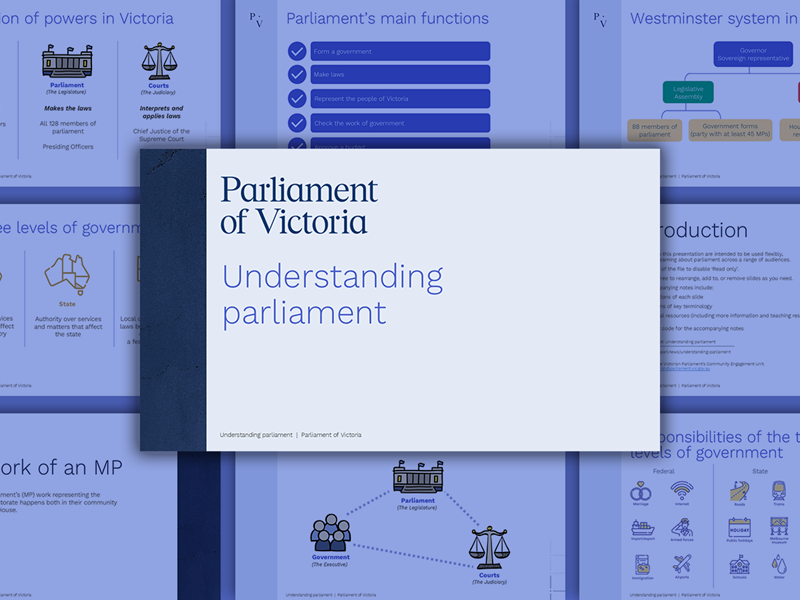
This slide deck, and accompanying teaching notes, provides explanations of the core concepts, processes and systems of parliament, with a specific focus on Parliament of Victoria.
The slide deck is divided into sections, and is intended to be used flexibly by selecting, rearranging and deleting slides. Where possible, the concepts have been represented using images and/or flowcharts. The sections include:
- Parliament
- The work of an MP
- Representation across the two chambers
- Process of making laws
- Committee inquiries
- Engaging with parliament
The accompanying notes include: relevant resources, including teaching and additional resources; definitions of key terminology relating to each section; and one-page explanations of each of the concepts.
The slide deck can be used to:
- introduce core concepts
- build students' understanding of parliamentary processes
- develop disciplinary-based literacy skills
- explore ways of engaging with Victoria's democratic systems
This resource is appropriate for Grades 5 through to VCE, specifically when investigating concepts around systems and levels of government, separation of powers, representation, parliament processes, and how to engage with parliament.
Grades 5 & 6
At Grades 5 & 6 students “describe the roles and responsibilities of the three levels of government" (VCCCG009), "identify the roles and responsibilities of electors and representatives in Australia's democracy" (VCCCG011) and "explain how state ... laws are initiated and passed through parliament" (VCCCL012).
Years 7 & 8
At Years 7 & 8 students "describe key features of government ... including the separation of powers, the Executive, the role of the houses of parliament [sic], and the division of powers" (VCCCG018) and "explain how citizens can participate in [Victoria's] democracy, including the use of the electoral system, contact with their elected represenatives ... and direct action" (VCCCG020).
Years 9 to 10
At Years 9 & 10 students “discuss the role of political parties and independent representatives ... including the formation of governments, and explain the process through which government policy is shaped and developed" (VCCCG028) and "discuss challenges to and ways of sustaining a resillent democracy and cohesive society" (VCCCC036).