A fair go for every Victorian facing cancer
15 May 2026

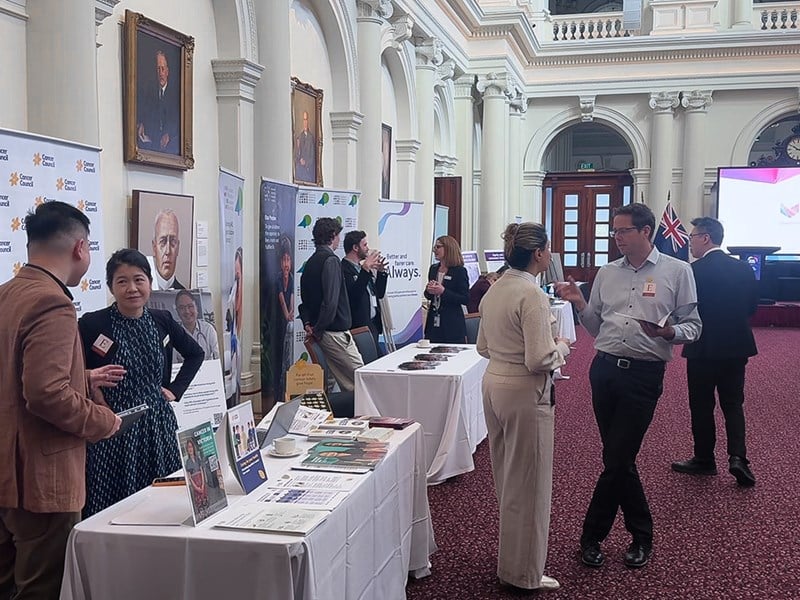
A major cancer awareness exhibition has been held at Parliament House bringing together leading organisations, clinicians, researchers and advocates to highlight both the progress and challenges in cancer care across Victoria.
The event, organised by the Victorian Comprehensive Cancer Centre Alliance (VCCC Alliance), featured contributions from organisations including Cancer Council Victoria and the Peter MacCallum Cancer Centre alongside hospitals, universities and medical research institutes working to improve outcomes for Victorians affected by cancer.
Exhibitors showcased advances in cancer treatment, research and patient support services, while also drawing attention to growing pressures facing Victoria’s healthcare system.
New projections presented by the VCCC Alliance show annual cancer diagnoses in Victoria are expected to rise from almost 40,000 cases to around 60,000 by 2039, driven by population growth and ageing.
The exhibition also highlighted inequities in cancer outcomes across the state. Regional Victorians are significantly more likely to die from cancer, while Aboriginal Victorians and people from disadvantaged communities continue to face poorer outcomes and barriers to accessing timely care.
VCCC Alliance Chair Professor Sanchia Aranda said the exhibition was an opportunity to both celebrate Victoria’s world-class cancer system and advocate for improvements.
‘Today the Victorian Comprehensive Cancer Centre Alliance is shining a spotlight on cancer,’ Professor Aranda said.
‘We have our members — leading cancer hospitals, medical research institutes and universities — showcasing the great work happening around Victoria, but we’re also pointing out where the gaps are and arguing for investment to make sure that no person with cancer is left behind.’
Professor Aranda said a stronger, more connected and data-driven system was needed to better identify service gaps and improve access to care, particularly for regional and First Nations communities.
VCCC Alliance Chief Executive Officer Professor David Ashley also addressed the exhibition, warning that Victoria’s cancer system was approaching a critical turning point.
Having recently returned to Australia after a decade working in the United States, Professor Ashley said he had seen firsthand the risks of fragmented healthcare systems and growing inequity in cancer care.
‘One thing that resonates with me is a fair go for everybody,’ Professor Ashley said.
‘I think that’s the case at the moment in Victoria, but there is a risk with the burden of cancer that we will see people falling off and not getting a fair go in their cancer care journeys.’
A powerful feature of the exhibition was the inclusion of lived experience advocates, including childhood cancer survivor Seamus Flagg.
Diagnosed with Ewing sarcoma shortly before his 12th birthday, Mr Flagg underwent an intensive year-long treatment program involving repeated chemotherapy cycles and extended hospital stays. Now aged 26, he advocates for improved survivorship care, better support for families and carers, and greater access to specialised services in regional communities.
Mr Flagg also emphasises the importance of ensuring lived experience helps shape cancer policy, research and healthcare delivery, particularly for people affected by rare cancers.
The exhibition reinforced the importance of collaboration between healthcare providers, researchers, advocacy groups and government to ensure all Victorians can access high-quality cancer care, regardless of where they live or their circumstances.