Not just following the herd: Shepparton shows it's more than just fruit and dairy
10 September 2026
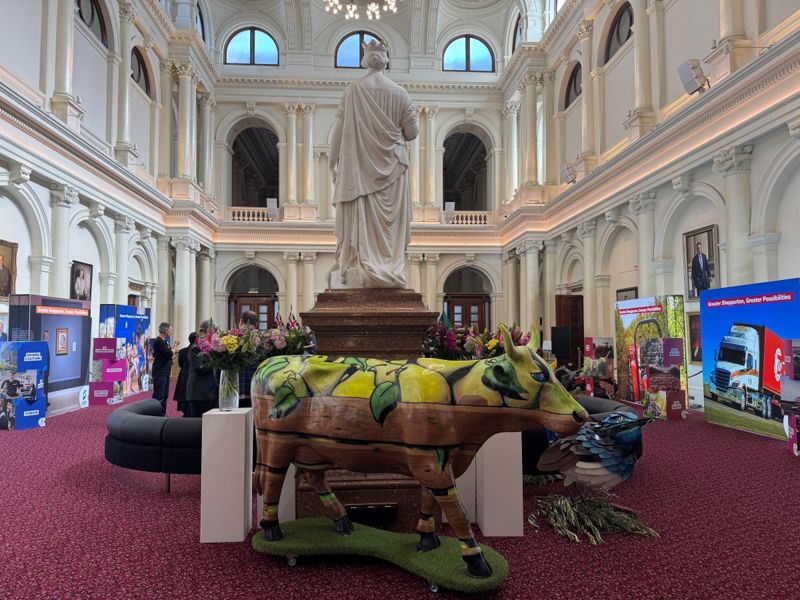
Many Victorians associate Shepparton with SPC and the Goulburn Valley's famous fruit industry but a new exhibition at Parliament House suggests that reputation barely scratches the surface.
There are familiar food brands, images of thriving industries, cultural attractions and reminders of the region's agricultural heritage.
Then there are the cows.
More than 90 colourful cows appear in town centres, parks, streetscapes and villages in and around Shepparton. Some celebrate local industries, others tell stories about community life, and a few simply bring a smile. Together, they form the region's beloved Moooving Art trail, one of Victoria's most distinctive public art attractions.
According to Greater Shepparton Deputy Mayor and dairy farmer Geoff Akers, the ever-growing herd has become much more than a collection of sculptures.
‘It's a reason for people to come and look around,’ he says.
The showcase is designed to help Victorians understand the scale, diversity and significance of a region that sits just around two-and-a-half hours from Melbourne but plays an outsized role in Victoria's economy.
The region sits at the heart of one of Australia's most productive agricultural zones. The Goulburn Valley grows around 80 per cent of the nation's pears and nashi pears and more than 60 per cent of Australia's stone fruit production.
Behind those numbers sits an extensive manufacturing sector that transforms local produce into products sold across Australia and around the world.
Campbell's Soups remains one of the region's iconic employers, while multinational companies such as Unilever operate major facilities in nearby Tatura.
‘They're not always locally recognised brands, but they're produced and processed right there in Greater Shepparton.’
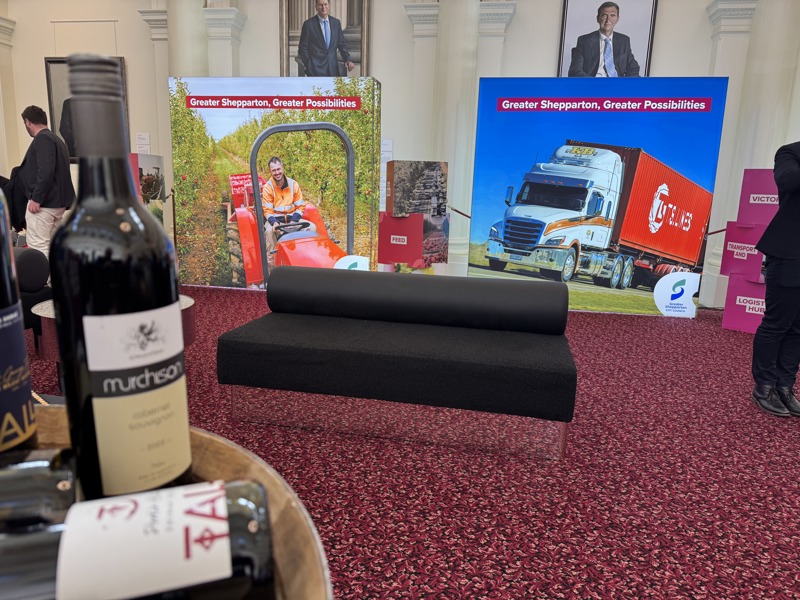
Dairy is equally important. Northern Victoria produces around 20 per cent of Australia's milk, while about 30 per cent of the nation's milk processing occurs in the region.
The result is a regional economy built not only on farming but on transport, logistics, manufacturing and food processing.
According to Akers, approximately a quarter of Victoria's freight movements pass through Shepparton, making it one of the state's most significant transport hubs.
The exhibition also highlights Shepparton’s growing reputation as a cultural destination.
At the centre of that transformation is the Shepparton Art Museum, known as SAM, whose striking lakeside building has become a regional landmark.
For the past four months, the museum has hosted works by Pablo Picasso. Now, visitors can also experience the Archibald Prize exhibition, with dozens of finalist works on display alongside the winning portrait.
‘How often are you going to get that in a regional centre?’ Akers asks.
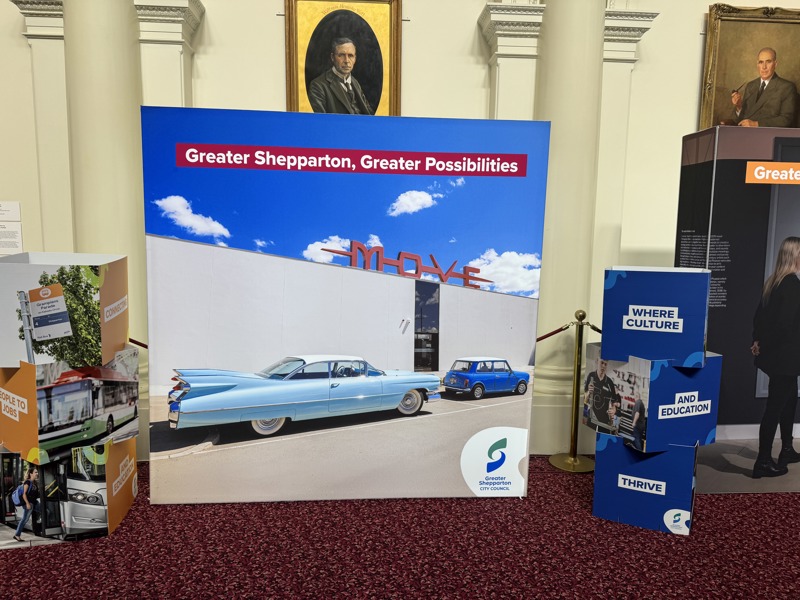
A short distance away is MOVE, the Museum of Vehicle Evolution, home to extensive collections of cars, trucks and buses.
‘If you're into transport at all, you'll be there all day,’ he says.
The exhibition's message is not simply that Greater Shepparton is succeeding. It is also that growth requires investment.
Greater Shepparton built more houses than any other regional centre in Victoria last year, according to Akers, and growth is expected to continue.
The municipality's population of approximately 65,000 to 70,000 people is forecast to increase significantly over the coming decade.
That expansion is being driven by strong agricultural and manufacturing sectors, along with a long tradition of migration.
‘We've had a strong migrant population coming through Greater Shepparton for 100 years,’ Akers says.
People arrive seeking work, opportunity and home ownership, contributing to a multicultural community that has become one of the city's defining characteristics.
But growth creates pressure.
Housing estates require roads, sewerage and water infrastructure. Health services need to keep pace with demand. Sporting facilities built decades ago are struggling to serve a growing population.
Among the council's highest priorities is redevelopment of the city's ageing basketball stadium.
‘It's as old as me,’ Akers says. ‘It's creaking and it's leaking.’
The proposed project would include four new courts and a showcase venue capable of seating 3000 spectators, helping Shepparton strengthen its claim as a major sporting destination.
Health infrastructure is another pressing concern. Greater Shepparton serves a catchment of about 250,000 people across northern Victoria and southern New South Wales, yet many residents still travel long distances for specialist cardiac and cancer treatment.

For Akers, the exhibition's most important message is that Greater Shepparton should be seen not as a distant regional community, but as a vital part of Victoria's future.
And with nine daily train services linking the city to Melbourne, he says visitors can easily spend a day exploring its museums, galleries, food culture and surrounding countryside.